
Views: 0 Author: Site Editor Publish Time: 2026-06-02 Origin: Site
Industrial digital metal printing lines are advanced production systems designed to print high-quality graphics directly onto coated metal sheets. Using non-contact industrial inkjet technology and UV ink, these lines enable packaging manufacturers to produce colorful, precise, and customized metal packaging without printing plates.
They are widely used for food cans, beverage cans, aerosol cans, fancy tins, twist-off caps, crown caps, general line cans, and chemical containers.
Unlike traditional offset printing, digital metal printing allows manufacturers to switch designs quickly, reduce make-ready waste, and handle short-run or multi-version orders more efficiently.
Core Definition and Function
An industrial digital metal printing line is not just a single printer. It is a complete metal decorating system designed for continuous industrial production.
The process usually includes sheet feeding, coating or pre-coated sheet preparation, hot air drying if required, digital inkjet printing, UV-LED curing, optional varnishing, and automatic stacking.
The metal sheets move smoothly through the line, while industrial printheads apply UV ink directly onto the coated metal surface. The printed image is then cured instantly by UV-LED drying, allowing the sheets to move quickly to the next production stage.
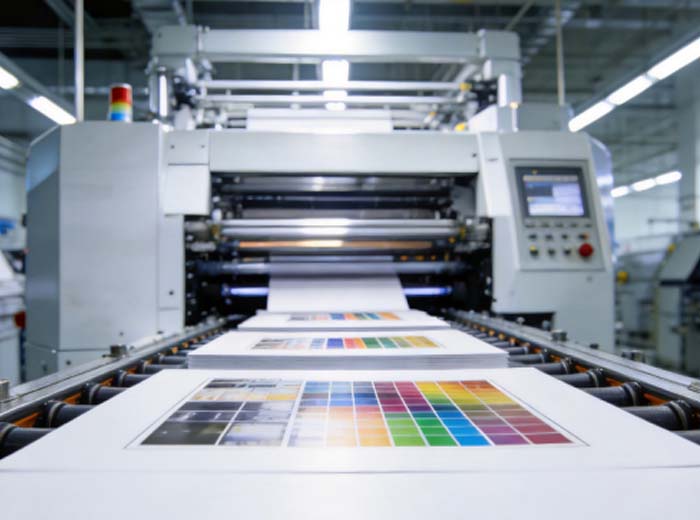
Here is a table that shows the main parts and features of industrial digital metal printing lines:
Component | Description |
|---|---|
Integrated Digital Metal Printing Line | Transforms metal sheets into high-quality printed packaging with plate-free digital inkjet precision. |
Key Features | Speeds up to 50 m/min, supports various feed sizes, enables instant design changes. |
Process Flow | Feeding, Coating, Hot Air Drying, Inkjet Printing (UV Ink), UV Drying, Varnishing, Stacker. |
Technical Specifications | Up to 600 × 1200 dpi resolution, CMYK + White ink configurations, equipped with Kyocera KJ4A-AA printheads. |
Digital vs. Offset Metal Printing
Traditional offset metal printing is highly efficient for large-volume repeated orders. However, it requires printing plates, longer setup time, and more make-ready sheets before stable production begins.
Digital metal printing works directly from a digital artwork file. No plates are required. This allows manufacturers to change designs quickly, print small batches, and produce multiple versions in one production plan.
Item | Offset Metal Printing | Digital Metal Printing |
Printing Plate | Required | Not required |
Setup Time | Longer | Shorter |
Design Change | Time-consuming | Fast and flexible |
Make-ready Waste | Higher | Lower |
Best For | Long runs and repeated orders | Short runs, medium runs, multi-version orders, and customized packaging |
Personalization | Limited | Easy |
Digital printing is not intended to replace offset printing completely. Instead, it works as a strong supplement to traditional offset lines. Offset printing remains cost-effective for long and stable orders, while digital printing gives manufacturers more flexibility for short-run, urgent, seasonal, and customized packaging projects.
How Industrial Digital Metal Printing Lines Work

1、Sheet Feeding
Metal sheets are loaded into the feeding system. Stable sheet feeding is essential for accurate registration and continuous production.
2、Sheet Conveying
The sheets are transported smoothly through the line. A stable conveying system helps reduce vibration, misalignment, and sheet waste.
3、Digital Inkjet Printing
The design is printed directly onto the coated metal sheet using industrial inkjet printheads. Since no printing plates are needed, job changes can be completed quickly by switching the digital artwork file.
This is especially useful for packaging manufacturers who need to handle multiple designs, different languages, limited editions, or regional packaging versions.
4、UV-LED Curing
After printing, UV-LED curing dries the ink instantly. This allows the printed sheet to move forward without waiting for long drying times.
UV-LED curing also supports high productivity, lower energy consumption, and stable print performance.
5、Optional Varnishing and Final Output
Depending on the final application, the printed sheet can go through an optional varnishing process for additional surface protection, gloss, or functional performance.
Finished sheets are then stacked automatically for the next process, such as cutting, slitting, forming, or can making.
Inkjet and UV Curing Technology
At the heart of the digital metal printing line are industrial inkjet printheads. H&Z digital metal printing lines can be equipped with Kyocera KJ4A-AA printheads, which offer 600 dpi native resolution and precise droplet control.
Technology | Description |
Non-Contact Inkjet Printing | Applies ink without mechanical pressure, making it suitable for coated metal surfaces. |
High-Performance UV Ink | Provides strong color performance, good adhesion, scratch resistance, and durability. |
UV-LED Curing | Enables instant drying, high productivity, energy saving, and stable production. |
White Ink Printing | Improves opacity and image vividness, especially on dark or metallic substrates. |

For metal packaging, white ink is particularly important. It helps create a stronger base layer, improves color brightness, and makes the final image closer to traditional offset printing quality.
Key Advantages of Digital Metal Printing Lines
1、High Flexibility and Customization
Digital metal printing lines give manufacturers greater production flexibility. Since there are no plates, it is easy to change designs, print different versions, and handle variable data.
This allows factories to accept more types of orders, including small batches, customized packaging, promotional designs, regional editions, and seasonal packaging.
2、Faster Turnaround Time
Without plate-making and long setup procedures, digital printing significantly shortens the preparation time before production.
Manufacturers can respond faster to customer requests, new product launches, urgent orders, and market testing projects.
3、Lower Make-ready Waste
Traditional offset printing often requires more make-ready sheets during setup and color adjustment. Digital printing reduces this waste because the image is printed directly from the digital file.
This helps lower production costs, save materials, and support more sustainable packaging production.
4、High Print Quality
With advanced industrial printheads, digital metal printing can achieve fine details, sharp text, smooth gradients, and vivid colors.
H&Z digital metal printing lines can support up to 600 × 1200 dpi resolution, CMYK + White ink configurations, and different print modes according to the customer’s production needs.
5、Suitable for Short and Medium Runs
For long and repeated orders, offset printing remains a strong solution. However, for short and medium runs, digital printing offers better flexibility and lower setup cost.
It is especially suitable for products with frequent artwork changes, multiple SKUs, or limited-edition packaging.
Applications in Metal Packaging

Food, Beverage, and Aerosol Cans
Digital metal printing lines can be used for metal sheets that are later formed into food cans, beverage cans, and aerosol cans. The technology supports vibrant graphics, fine details, and short-run production for new products, special editions, or regional market testing.
Fancy Tins and Gift Packaging
For fancy tins, gift boxes, tea tins, chocolate tins, and promotional packaging, appearance is extremely important. Digital printing allows brands to create personalized, limited-edition, and high-value packaging with lower minimum order quantities.
Twist-off Caps and Crown Caps
Digital printing is also suitable for twist-off caps, crown caps, and other small metal packaging products that require multiple designs or frequent version changes.
General Line and Chemical Cans
For paint cans, lubricant cans, chemical containers, and industrial packaging, artwork often needs to be updated due to product information, warning labels, market regulations, or language versions.
Digital printing allows manufacturers to update these designs quickly without making new plates.
Why Choose H&Z as Your Digital Metal Printing Partner?
Choosing a digital metal printing line is not only about buying a machine. It is about building a reliable production solution.
H&Z is a joint venture focused on integrated metal packaging solutions. We understand that can makers and metal packaging manufacturers need stable equipment, practical configurations, fast technical response, and long-term after-sales support.
End-to-End Support
We support customers from project evaluation, sample testing, technical discussion, installation, operator training, and future production support.
Customized Configurations
We do not simply offer one standard machine. Our technical team can recommend suitable configurations based on your sheet size, product application, production speed, print quality requirements, and investment budget.
Smooth Integration with Existing Production
Digital metal printing can work together with your existing offset printing, coating, cutting, and can-making processes.
Our goal is to help customers add digital flexibility without disrupting their current production system.
Long-Term Reliability
H&Z focuses on stable operation, consistent print quality, practical service support, and reliable spare parts supply. We aim to build long-term cooperation with metal packaging manufacturers worldwide.
FAQ
Why do manufacturers choose digital metal printing lines?
Manufacturers choose digital metal printing lines because they offer high flexibility, fast design changes, short-run production capability, and lower make-ready waste.
They are especially useful for customized packaging, seasonal designs, promotional products, and multiple-SKU production.
What are the advantages of having more printheads?
More printheads mainly bring two advantages.
First, they allow a wider printing width, which is important for larger metal sheets.
Second, they can improve printing flexibility and color performance, especially when printing white ink or high-coverage designs.
For metal packaging, white ink is very important because it helps improve opacity, color brightness, and the overall visual effect.
Why do we suggest using a corona treater?
Corona treatment helps improve the surface energy of the coated metal sheet. This allows UV ink to spread and adhere better on the surface.
For digital metal printing, ink is jetted directly onto the coated metal sheet. If the surface energy is too low, the ink may not adhere properly. Corona treatment helps reduce this risk and improves printing stability.
It is especially recommended when customers use different coated sheets or when the surface condition is uncertain.
Does a corona treater create a safety hazard?
No. A corona treater is not considered a safety hazard when it is properly designed and operated.
Corona treatment is a mature industrial technology widely used in printing and packaging. A proper system includes safety protection, grounding, ventilation, and interlock design.
Like other industrial electrical equipment, it should be operated according to the machine manual and safety instructions.
How much area can 1 liter of UV ink print?
As a rough reference, based on an average ink coverage of around 70%, 1 liter of UV ink can print approximately 285 square meters.
However, actual ink consumption depends on the artwork design, color coverage, white ink usage, printing resolution, and final image density.
If the design includes large solid color areas or heavy white ink coverage, the printable area will be lower.
If customers provide the actual artwork and sheet size, H&Z can help estimate the approximate ink cost per sheet more accurately.
How does digital printing reduce manufacturing waste?
Digital printing does not require printing plates, which reduces plate-making waste and make-ready sheets.
Since the image is printed directly from the digital file, setup is faster and more efficient. This helps reduce material waste, save production time, and support more sustainable manufacturing.
How does digital printing work with traditional offset printing?
Digital printing is not a replacement for offset printing. It is a strong supplement.
Offset printing remains suitable for large-volume repeated orders. Digital printing is better for short-run, fast-changing, customized, and multi-version orders.
Together, they allow metal packaging manufacturers to serve a wider range of customer needs.
⸻
Conclusion
Industrial digital metal printing lines are changing the way metal packaging is produced. By combining plate-free inkjet printing, UV-LED curing, flexible design changes, and high-quality output, digital printing gives manufacturers a smarter solution for short and medium runs.
For can makers and metal packaging companies, digital metal printing is not only a new printing method. It is a way to improve flexibility, reduce waste, respond faster to customers, and open new business opportunities.
With integrated equipment solutions, customized configurations, and long-term technical support, H&Z is ready to help customers build a more flexible and competitive metal packaging production system.


